Astatula Mayor Says Political Conflict Has Pushed His Family Toward Leaving Town
Astatula Mayor Zane Teeters says political disputes have taken a personal toll on his family. His statement comes amid a state DOGE review questioning town operations.
Mayor Zane Teeters says political disputes may cause his family to leave Astatula as the town faces questions arising from a state DOGE review.
The state review raises specific concerns about personnel authority, employee turnover, contracting, financial controls and potential nepotism. Public accountability requires documented answers.
Residents, taxpayers, employees and elected officials have an interest in lawful town procedures and reliable services. No representative public-confidence measurement has been identified.
The mayor has raised the possibility of leaving, but no resignation or move has been confirmed. The state findings still require a documented town response.
Records from the October 8 workshop, town responses, procurement and personnel documents, and related ethics proceedings will clarify the issues.
What Happened
Astatula Mayor Zane Teeters has provided Lake County Now with a first-person statement saying political disputes may lead him and his wife, Dawn, to leave town. His remarks come as the municipality faces scrutiny following a Florida DOGE review raising questions about personnel decisions, purchasing practices, financial oversight and town leadership. The mayor's account describes his family's experience but does not resolve the government's findings.
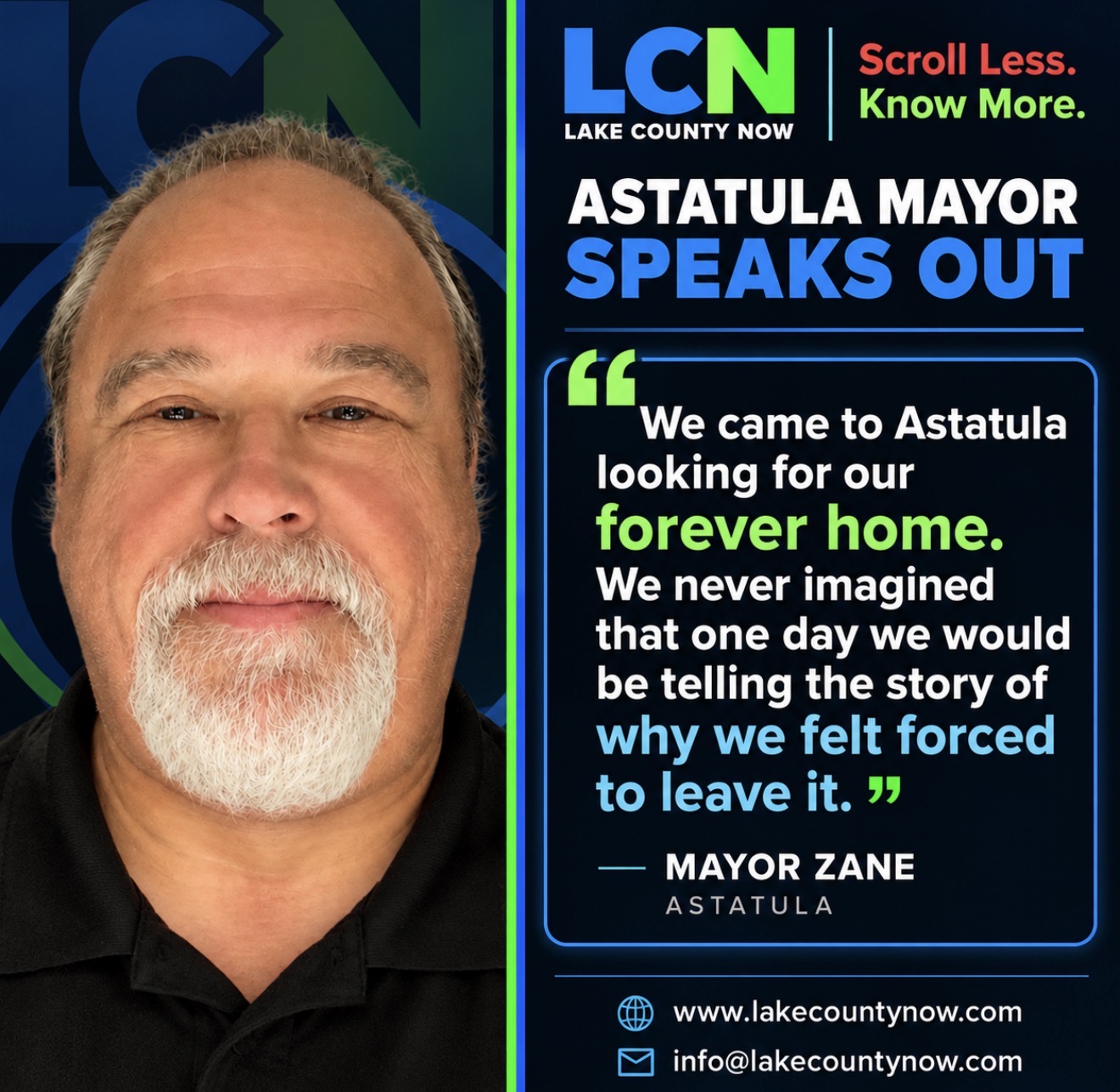
“We came to Astatula looking for our forever home. We never imagined that one day we would be telling the story of why we felt forced to leave it,” the mayor wrote.
Teeters says he entered town government in 2022 to address infrastructure, public safety, development and municipal accountability. He was elected mayor in 2024. His statement describes responding to emergencies, helping residents outside normal government duties and receiving $500 monthly for his role.
He has not announced his resignation or confirmed a relocation date.
Astatula Issues Written Response to DOGE Findings
Read the Town of Astatula's Full Response to the DOGE Report
VIEW THE TOWN'S COMPLETE SEVEN-PAGE RESPONSE (PDF)
Lake County Now has obtained a seven-page Town of Astatula staff response dated October 8, 2026, compiled by Town Attorney David M. Langley. The document responds point by point to the state's September 30 “Astatula Efficiency and Governance Review.” It provides the town's explanations and disputes several conclusions, while also acknowledging shortcomings in recordkeeping and staffing. The town's response is not an independent adjudication of the DOGE findings.
Personnel authority and turnover: The response argues that a 2008 personnel manual, reaffirmed by a 3–2 Town Council vote in July 2025, delegates day-to-day hiring and firing authority to the mayor while preserving an employee's right to appeal to the Council. Town staff acknowledges high employee turnover but says many departures were resignations, not unilateral terminations. The document says one public works director resigned before receiving a drafted termination notice, while a police officer's termination was rescinded after legal review.
Dawn Teeters and community events: Town staff states that Dawn was an unpaid volunteer, not a municipal employee, and says the Council established a Community Events Committee in November 2025 under what the town attorney interprets as an applicable state-law exception. According to the response, she left the volunteer position on October 5, 2026. These explanations address the appointment and nepotism questions; they do not independently establish the disposition of any separate financial allegation.
Legal fees and ethics questions: The response says the Town Council voted 4–1 on April 29, 2026, to approve legal fees after receiving the town attorney's advice on when a public official's defense may be paid with public funds. It states that insurance reimbursement of up to $100,000 would depend on the mayor being cleared of wrongdoing. Whether the legal analysis resolves DOGE's concerns remains a separate question.
Contracts and financial records: The town says four questioned paving awards were unanimously approved by the Council and that three related checks had the required two signatures. It acknowledges that bid waivers and sole-source justifications should have been documented more clearly, and says one check bearing only the clerk's signature was likely an oversight. The response also says outside accounting firm James Moore stopped serving as independent auditor before undertaking broader financial-management work. Town staff acknowledges other documentation weaknesses and describes planned reviews or corrective steps.
What remains unresolved: The response says the town produced more than 2,000 pages of records and requested an opportunity to provide context before the state review was issued. It also says DOGE had not responded to requests for more detail about certain allegations. These assertions are the town's position as of October 8. Readers should consider both the state's findings and the town's documented explanations when assessing municipal oversight and public confidence.
Why It Matters
The statement follows a September 30, 2026, Florida Department of Government Efficiency (DOGE) review. According to October 6 reporting by Florida Politics, investigators raised concerns about high employee turnover, the authority used for personnel decisions, possible nepotism, incomplete contract records and procurement practices. These are matters of municipal governance and accountability regardless of the mayor's personal response.
Florida Politics reported that the review questioned four roadwork contracts totaling $71,267 that lacked documented sole-source justification, a $20,000 advance payment, and eight unsigned contracts among 17 examined. DOGE also questioned Dawn Teeters' appointment to a community-events role as a potential nepotism issue. These reported findings warrant scrutiny of purchasing controls, appointment procedures and documentation. They do not, by themselves, establish a criminal offense or prove misappropriation of event funds.
In his account, Teeters described Dawn's volunteer work organizing local festivals, Christmas gifts, food distributions and a Thanksgiving dinner serving more than 100 people. He disputed accusations that she personally profited from those activities.
The DOGE findings and the mayor's response address different questions. Teeters describes the personal consequences of public criticism; the state review addresses whether town officials followed applicable procedures. Residents need documentary explanations of the questioned decisions, not only competing accounts of political motives.
Who It Affects
Residents, municipal employees, taxpayers and elected officials have a direct interest in the town's handling of personnel decisions, public spending and oversight. These disputes raise questions about confidence in municipal leadership, but LCN has not identified a representative survey measuring public confidence in Teeters or the Town Council. Criticism at meetings or online should not be presented as evidence of a townwide majority view.
Teeters specifically named Ryan Wilbur, Kay MacQueen and Mrs. Huskey, alleging that their conduct contributed to an increasingly hostile political environment. Those are his allegations. LCN has not independently established that the named individuals coordinated a campaign against him or his family.
The mayor also says he advocated for police employees' health insurance and compensation, and that later personnel disagreements strained relationships. Those claims are attributed to his statement.
What Changes
The mayor has publicly raised the possibility that he and Dawn will leave Astatula, but has not announced a resignation or confirmed a move. The state's reported findings remain unresolved by his statement. The practical issue for town government is whether questioned procedures will be explained, corrected or defended with supporting records.
What’s Next
The town's response to the DOGE findings, records of personnel and purchasing decisions, and the status of related ethics proceedings remain important. An October 8 workshop was scheduled to address the review; its records and any resulting actions should establish what the town has acknowledged, disputed or committed to change.
Teeters' next steps regarding his office and residency have not been announced. LCN will continue covering the municipal review, relevant public records and responses from the people involved.
Mayor Zane Teeters’ Full Statement to Lake County Now
The following remarks were provided directly to Lake County Now by Mayor Zane Teeters and reflect his personal account:
“We Came Here to Build a Life. Now We Feel We May Have to Leave.
Dawn and I did not come to Astatula looking for power, politics, attention, or controversy.
We came here looking for something much simpler.
We wanted a home.
We wanted a small town where neighbors knew one another, where people still waved when they drove by, where children could grow up knowing the people around them, and where community still meant something.
We saw something special in Astatula.
We wanted to be part of it.
We put down roots here. We built relationships here. We opened a small business here. We volunteered here. We attended events, helped residents, supported our police officers and employees, and gradually invested almost every part of our lives into this little town.
What neither of us understood was how much Astatula would eventually ask of us—or how much the politics surrounding it would eventually take from us.
I Never Intended for Politics to Become Our Life
I became involved in Town government because I believed I could help.
I began serving on the Town Council in 2022. I learned about the water system, roads, parks, police department, budgets, development and the hundreds of small problems that come with operating a small municipality.
Eventually, I ran for Mayor.
I did not run because I wanted a title.
I ran because I believed Astatula was worth protecting.
I was concerned about growth occurring faster than our infrastructure could handle it. I wanted better parks. I wanted investment in our aging water system. I wanted responsible spending, better accountability and a government that actually answered residents when they called.
When I was elected Mayor in 2024, I understood that I had been entrusted with something important.
What I didn’t fully understand was that, in a town this size, being Mayor doesn’t end when Town Hall closes.
It doesn’t end when the Council meeting adjourns.
It doesn’t end at five o’clock.
Being Mayor of Astatula has been a 24-hour-a-day, seven-day-a-week responsibility.
And for that responsibility, I receive $500 a month.
That’s $6,000 a year.
There are easier ways to make $500.
There are certainly easier ways to make $500 without having your character questioned, your family attacked and virtually every decision you make examined under a microscope.
But I didn’t do it for the $500.
I did it because this was our home.
What Being Mayor Really Looks Like
Most people see the meetings.
They see the Mayor sitting behind the nameplate.
They see a Facebook post, a proclamation or a photograph at an event.
They don’t always see everything that happens when nobody is taking pictures.
They don’t see the nights when a storm is raging outside and the power goes down at the Town well.
There have been times when Dawn and I have gotten out of bed in the middle of the night, gotten dressed and gone out into the storm because the well was down and people needed water.
There is no time clock.
There is no overtime.
There is simply the knowledge that hundreds of people are depending upon that system, and somebody has to respond.
That’s what we did.
They don’t see the call from a frightened child who needs emergency assistance but cannot explain where they live.
I remember working through one of those situations along with an Astatula Police Department officer—trying to communicate with that child, piece together enough information to determine where they were, and get help headed in the right direction.
In that moment, you’re not thinking about politics.
You’re not thinking about the next election.
You’re not thinking about whether somebody likes you on Facebook.
You’re thinking:
Find that child.
That’s the job too.
Then there are the calls that technically aren’t the Mayor’s responsibility at all.
An elderly resident called me distraught because they had been unable to make it to one of our food distributions.
They needed food.
There wasn’t a government program I could activate at that moment. There wasn’t a Council vote to take. There wasn’t a form to fill out.
There was simply an elderly person in my community who needed help.
So I went to Publix.
I bought groceries for them with the money I had intended to use to buy groceries for my own household.
I don’t tell that story looking for praise.
I tell it because that is the Astatula Dawn and I believed in.
If somebody needed help and you could help them, you did.
That’s what community meant to us.
And those examples are not isolated from the job.
They are the job.
The Mayor’s phone doesn’t know whether it’s Christmas morning, Sunday night, two in the afternoon or two in the morning.
When residents call because their water is out, because something is happening on their street, because they’re frightened, because they’re angry, because they’re confused, or sometimes simply because they don’t know who else to call, I answer it, every time.
That is what I believed I signed up to do.
And Dawn lived that life alongside me.
Except Dawn received nothing for it.
Zero.
Dawn Never Asked for Any of This
That may be the part of this story that hurts the most.
Dawn didn’t run for Mayor.
She didn’t ask to become a political figure.
She wanted to help her community.
She volunteered countless hours helping organize community events and serving as the Town’s Community Events Coordinator.
She did it for zero compensation.
No salary.
No monthly stipend.
No paycheck.
She did it because she loved doing things for this community.
And saying that Dawn “organized events” does not begin to describe what that actually meant.
With the help of a small and dedicated group of volunteers, Dawn spent countless hours helping put together the kinds of events that make a small town feel like a community—our Fall Festival, Back-to-School activities, food distributions, Trunk-or-Treat, Light Up Astatula, the Police Charities Thanksgiving Dinner and other community and holiday gatherings throughout the year.
Those events did not magically happen.
Someone had to make the calls.
Someone had to contact vendors.
Someone had to coordinate entertainment.
Someone had to find volunteers.
Someone had to answer questions.
Someone had to arrange setup.
Someone had to solve the problems that inevitably came up at the last minute.
Someone had to be there before everyone arrived and remain after everyone else had gone home.
Much of the time, that person was Dawn, working alongside a very small group of people who repeatedly stepped forward to help.
Light Up Astatula
Light Up Astatula is a perfect example of the work people never saw.
It wasn’t simply putting up decorations and inviting families to come celebrate Christmas.
Dawn helped order hundreds of gifts for the children of Astatula.
Then those gifts had to be received, sorted and wrapped.
And it wasn’t enough just to have a pile of presents.
She worked to make sure there was something appropriate for every child who might walk through that door—from an infant to a teenager, boys and girls of different ages.
That meant thinking ahead.
How many gifts were available for babies?
How many for young boys?
How many for young girls?
What about older children and teenagers, who are sometimes forgotten at Christmas events designed around little kids?
The gifts had to be separated by age and category, wrapped and organized so that when families arrived, the goal was simple:
No child from Astatula should leave feeling forgotten.
People saw the lights.
They saw Santa.
They saw children opening presents.
What they did not see were the hours spent ordering hundreds of gifts, sorting them across a room, wrapping them one after another, checking age groups and making sure there would be enough so that a child—from infancy through their teenage years—would have something waiting for them.
Dawn and that small group of volunteers did that because they wanted the children of this town to have a special Christmas.
Not because they were being paid.
They weren’t.
Not because somebody required them to.
Nobody did.
They did it because they cared.
The Police Charities Thanksgiving Dinner
Thanksgiving was another example.
For the Police Charities Thanksgiving Dinner, Dawn helped coordinate a meal large enough to feed more than 100 people.
That meant arranging for 14 turkeys to be cooked, two hams, all of the traditional fixings, and everything else that goes into feeding a crowd that size.
It meant making sure the food was ready.
It meant setting up the Community Center.
It meant arranging tables and serving areas.
It meant coordinating volunteers.
It meant making sure there was enough food for everyone who came through the doors.
And then it meant serving more than 100 people a Thanksgiving meal.
To someone attending, it may have looked simple: walk in, sit down, eat and enjoy the company of neighbors.
But meals for more than 100 people do not simply appear.
Fourteen turkeys do not cook themselves.
Two hams do not prepare themselves.
The side dishes do not arrive, arrange themselves, stay hot and get served without somebody organizing every step.
The tables do not set themselves up.
The Community Center does not clean itself afterward.
That work was done by Dawn and a small group of people willing to give their time so others could sit down and enjoy Thanksgiving.
Again, there was no paycheck.
There was no personal benefit.
There was simply a desire to make sure people in this community had a place to go, a hot meal to eat and neighbors to share Thanksgiving with.
And that same story repeated itself across event after event.
The public saw the Fall Festival.
They saw the children smiling.
They saw the food being handed out.
They saw the Thanksgiving plates.
They saw the Christmas gifts.
They saw the vendors, music, games, decorations and activities.
They didn’t see the weeks and sometimes months of work that went into making those few hours possible.
And there is something else that has become very difficult for us to ignore.
To my knowledge, many of the people who later complained the loudest about these events, criticized Dawn or questioned how things were being done were not the people standing beside her doing the work.
They weren’t the ones spending their weekends setting things up.
They weren’t the ones making phone calls.
They weren’t the ones staying late to clean up.
They weren’t the ones giving up their own time.
They weren’t the ones sitting among hundreds of Christmas gifts, sorting and wrapping them to make sure no child would be overlooked.
They weren’t the ones helping coordinate 14 turkeys, two hams and all the fixings so more than 100 people could sit down to Thanksgiving dinner.
The same small group of volunteers seemed to be there again and again.
It is easy to criticize something from the outside.
It is much harder to give up a Saturday, work in the heat, haul tables, coordinate vendors, distribute food, wrap hundreds of Christmas presents, prepare for a Thanksgiving meal for more than 100 people, entertain children, clean up afterward and then start planning the next event.
Dawn did that repeatedly.
Without a paycheck.
Without asking for recognition.
And without expecting anything in return.
Her Service Was Never Limited to Town Events
But even that does not tell the whole story of who Dawn has been to people in this community.
Some of the things she has done were never official Town activities at all.
They were simply one human being helping another.
There have been residents who needed transportation to doctors’ appointments.
Dawn drove them.
There have been residents who had to go to the emergency room or be admitted to the hospital and did not have someone who could be there with them.
Dawn sat with them.
Sometimes for hours.
Sometimes through days of uncertainty.
She has remained in emergency rooms and hospital rooms simply because someone was frightened, alone or needed another person sitting beside them.
There was no compensation for that.
There was no Town position requiring it.
There was no photograph for Facebook.
There was no recognition at a Council meeting.
She did it because somebody needed her.
There was also a family facing the very practical problem that getting their child to school every morning could mean a parent missing work.
So Dawn helped.
She drove that child to school every day so those parents could keep working and providing for their family.
Again, there was no paycheck.
There was no mileage reimbursement.
There was no political advantage.
It was simply something she could do to make another family’s life a little easier.
That is the woman I watched being accused of taking from this Town.
And that is why the accusation that she somehow used these events for personal benefit hurt so deeply.
Because I know what she actually gave.
Not just money.
Not just hours.
Pieces of her life.
Then Politics Reached Her Too
After everything she had given, Dawn was accused of pocketing event money.
That accusation cut deeply.
There has been no finding that Dawn stole Town money. No conviction. No adjudication that she pocketed Town event proceeds.
But once an accusation like that is spoken in a small town, sometimes the damage is accomplished before the facts ever catch up.
Think about the contrast.
A woman can spend years organizing events without compensation.
She can help distribute food.
She can spend countless hours making sure hundreds of children have a Christmas gift.
She can help coordinate Thanksgiving dinner for more than 100 people.
She can drive residents to medical appointments.
She can sit beside someone in a hospital because they have nobody else.
She can drive a child to school every morning so the parents can keep their jobs.
She can get out of bed in the middle of the night and go into a storm with her husband because the Town well has lost power.
She can give and give and give.
And then one accusation can suddenly make people question who she is.
After everything she had given, Dawn reached the point where she couldn’t continue.
She resigned.
And I watched the woman who had spent years trying to bring this community together become one of the casualties of its political division.
That changed something in me.
People are entitled to criticize me.
I ran for office.
Challenge my votes.
Challenge my policies.
Run against me.
Vote against me.
Stand at a meeting and tell me I’m wrong.
That’s democracy.
But my wife should never have had to sacrifice her peace and her reputation simply because she was married to the Mayor.
We Were Trying to Move Astatula Forward
Astatula has been facing enormous challenges.
Growth.
An aging water system.
Development pressure.
Public safety costs.
Roads.
Parks.
Staffing.
Budgets.
Code enforcement.
The everyday problems of trying to operate a municipality with a fraction of the staff and resources available to a large city.
I believed Astatula needed to slow development until our infrastructure had an opportunity to catch up.
I fought for improvements to our water system.
We worked on parks.
We worked on public safety.
We worked on infrastructure.
We worked on budgets and staffing.
And when I say I supported our Police Department, I do not mean only when it was convenient or politically popular.
I supported the people who wore the uniform in ways that affected their families, their health and their financial security.
At one point, the medical insurance available to our Police Department had been drastically reduced.
I believed that was unacceptable.
These were employees we were asking to work nights, weekends, holidays and dangerous calls. They were expected to protect this community when everyone else was running away from danger.
If we expected that level of commitment from them, I believed the Town had a responsibility to give them the strongest health coverage we could reasonably provide.
So I fought for it.
I pushed for the best coverage available to us, and I insisted that the Town provide that coverage without requiring the employee to pay a premium.
That may sound like a budget line until the day somebody actually needs it.
Then it becomes very real.
When one employee suffered a ruptured appendix, health insurance mattered.
When another employee faced a cancer diagnosis, health insurance mattered.
It mattered to those employees.
It mattered to their families.
And it mattered to me that an employee facing a medical crisis did not also have to wonder whether the health coverage we provided would leave them financially devastated.
That is what I believed supporting our employees meant.
Not simply saying, “We support our police.”
Actually supporting them when it counted.
And health insurance was not the only time I fought for them.
There was also an issue involving back pay that I believed our police officers were owed.
Others on the Council appeared to view the situation as unfortunate but something that did not necessarily need to be corrected.
I could not accept that.
If an employee performs work and compensation is legitimately owed, then, in my view, saying “that’s unfortunate” is not enough.
You correct it.
You make the employee whole.
You do not simply acknowledge that something went wrong and then expect the employee to absorb the loss.
So I fought to get those officers the back pay I believed they were due.
That was not about politics.
It was not about buying loyalty.
It was about a very simple principle:
If the Town owes an employee money, the Town should pay that employee what they are owed.
That was the standard I believed in whether the employee agreed with me, disagreed with me, supported me or never voted for me at all.
That is also why what happened later has been so difficult for me personally.
Some of the very employees I fought to protect financially and medically eventually became among my harshest critics.
Disagreements arose.
Personnel matters arose.
Policies had to be enforced.
Decisions were made that not everyone liked.
And accusations followed.
From my perspective, the memory of those earlier fights seemed to fade quickly.
The fight for better medical insurance.
The insistence that employees not be charged a premium for that coverage.
The effort to correct back pay that I believed officers were rightfully owed.
The willingness to stand up for employees when I thought they were being treated unfairly.
All of that seemed to become irrelevant once conflict developed.
I do not expect gratitude in exchange for doing what I believed was right.
I did not fight for their insurance so anyone would owe me political loyalty.
I did not fight for their back pay so anyone would owe me personal loyalty.
That would have been wrong.
But I would also be dishonest if I said it did not hurt.
It hurt to know that when those employees needed someone to argue for better health coverage, I fought for them.
It hurt to know that when I believed officers had been underpaid, I pushed to have it corrected even when others appeared willing to leave the matter alone.
It hurt to know that when medical emergencies became real, the coverage we fought to provide mattered enormously.
And it hurt when, later, some of those same people seemed willing to believe or repeat the worst about me.
There is a larger lesson in that.
Leadership sometimes means fighting for people who may never fight for you.
It means doing the right thing for someone even when you eventually disagree.
I would still argue that those employees deserved good health insurance.
I would still argue that officers should receive every dollar legitimately owed to them.
I would still argue that a police officer or Town employee facing a ruptured appendix, cancer or another medical crisis should not also be worried about whether they can afford the care they need.
Because supporting an employee should never depend upon whether that person supports you politically.
That was never how I approached the job.
We dealt with fires, water problems, boil notices, drought restrictions, storms and emergencies.
The Town continued operating through all of it.
And that point matters to me.
Whatever disagreements people have with me—and whatever criticisms have been raised about administrative decisions—Astatula did not cease functioning.
Police continued answering calls.
Water continued being provided.
Employees continued receiving paychecks.
Council meetings continued.
Budgets continued to be adopted.
Infrastructure projects continued.
Parks continued to improve.
Government continued operating.
I do not claim that every decision I have made was perfect.
Nobody who makes hundreds of decisions will get every one right.
But mistakes are not automatically corruption.
Disagreement is not corruption.
Asking questions is not corruption.
Trying to correct something you believe is wrong is not corruption.
And holding an employee accountable—or enforcing a policy someone dislikes—does not erase everything that came before it.
I know what my intentions were.
I was trying to help the Town I lived in and the people who worked for it.
Somewhere Along the Way, Disagreement Became Personal
Ryan Wilbur and I once served together.
Kay MacQueen and I have served together.
There were times we agreed and times we disagreed.
That’s supposed to be how representative government works.
But somewhere along the way, in my view, legitimate political disagreement changed into something else.
Based on what I have personally experienced, communications and records I have reviewed, public statements that have been made, complaints that have been filed, and events that have unfolded, I have come to believe that Mr. Wilbur, Ms. MacQueen, Mrs. Huskey and others developed a personal vendetta against me.
They may reject that characterization.
They are entitled to.
But I am equally entitled to describe what Dawn and I have experienced and the conclusions I have reached from it.
From our perspective, it stopped feeling like oversight.
It stopped feeling like policy disagreement.
It stopped feeling like politics.
It began feeling like an effort to discredit me personally and, eventually, to damage my family as well.
Complaints.
Accusations.
Rumors.
Public-record requests.
Social-media posts.
Allegations repeated as though they had already been proven.
Contacts with outside officials and agencies.
And eventually a state DOGE review whose allegations became public and political ammunition before, in my view, there had been a meaningful opportunity for everyone accused or criticized to provide the complete context and underlying records.
That doesn’t mean government officials shouldn’t be investigated.
They should be.
It doesn’t mean I should be immune from criticism.
I shouldn’t be.
It means there is a difference between accountability and destruction.
And from where Dawn and I stand, that line disappeared a long time ago.
What People Don’t Understand About Constant Accusations
Some people will say:
“You’re the Mayor. You should expect criticism.”
I do.
Criticism comes with the office.
But this has gone far beyond someone disagreeing with whether I supported a road project or how I voted on an ordinance.
Imagine living every day wondering what accusation will appear next.
Imagine opening your phone in the morning wondering what someone has posted about you overnight.
Imagine your wife crying because people in the community she volunteered for are questioning whether she’s honest.
Imagine fighting to get employees better health insurance.
Imagine fighting to recover back pay you believed officers were legitimately owed when others seemed prepared to let the issue end with little more than regret.
Imagine standing behind those employees when serious illness makes that health coverage critically important.
And then imagine later hearing some of those same people make accusations about you when disputes arise.
Imagine explaining allegations over and over even when no final finding supports the version being circulated.
Imagine spending evenings preparing documents, responding to records requests, answering complaints and defending decisions instead of sitting peacefully at home with your spouse.
Then imagine doing all of that for $500 a month.
And imagine your wife enduring it while receiving nothing at all.
That is the part of public service nobody puts in the campaign brochure.
Look at What We Actually Did
When the well goes down in a storm, we don’t ask who voted for me.
We get up.
When a child needs help, we don’t ask whether their parents support me politically.
We find the child.
When an elderly resident calls because they missed a food distribution and have nothing to eat, I don’t ask whether there’s a campaign sign in their yard.
I go buy the groceries.
Sometimes with money Dawn and I intended to use for ourselves.
When hundreds of children need Christmas gifts, Dawn doesn’t ask which families support us.
She makes sure there are gifts—from babies to teenagers, boys and girls—so that every child possible can go home with something.
When Thanksgiving comes and more than 100 people need a place to share a meal, she doesn’t ask about politics.
She helps arrange 14 turkeys, two hams, all the fixings, sets up the Community Center and helps make sure everyone is fed.
When someone needs to get to a doctor, Dawn doesn’t ask who they voted for.
She drives them.
When somebody is lying frightened in an emergency room without anyone beside them, she doesn’t ask whether they ever attended one of our events.
She sits down beside them.
When parents are trying to keep their jobs and their child needs a dependable way to school, she doesn’t ask what their politics are.
She helps the family.
And when our police employees needed better medical coverage, I did not ask whether they agreed with me politically.
I fought for the coverage.
When I believed officers were owed back pay, I did not ask whether they supported me.
I fought to have them paid what I believed they were due.
When serious medical emergencies later made that insurance important, I was grateful they had it.
That is the part I wish people understood.
Community service was never a slogan to us.
Supporting our employees was never supposed to depend on whether they liked us.
It was not something we did only when cameras were present.
Most of these moments happened when virtually nobody knew about them.
That’s who we tried to be here.
Maybe we weren’t perfect.
But our intentions were never to harm Astatula.
They were to help it.
I can live with people disagreeing with how I did that.
What has become almost impossible to live with is having our motives repeatedly portrayed as something ugly when we know what happened behind closed doors, in the middle of storms, late at night, inside hospital rooms, surrounded by piles of Christmas gifts, preparing Thanksgiving meals, fighting for employees’ health coverage, fighting for officers’ back pay and in quiet moments when nobody was watching.
We Came Here Looking for Peace
That’s why the ending to this story is so painful.
We came to Astatula because we wanted a simpler life.
We found a town we loved.
Then we became part of it.
Then we tried to help it.
Then helping it became serving it.
Serving it became consuming our lives.
And eventually the political fighting followed us all the way home.
This isn’t simply about an election anymore.
It isn’t even about whether I remain Mayor.
It’s about whether Dawn and I can ever have a normal life here again.
And I no longer believe we will be allowed to.
Why We Feel We Can No Longer Stay
People may ask:
If you love Astatula this much, why would you leave?
Because loving a place and being able to live peacefully in that place are two different things.
We wanted Astatula to be our forever home.
We believed it was.
But no family can remain healthy living permanently in anticipation of the next attack.
No wife should have to wonder whether volunteering at a community event will someday be twisted into an accusation against her.
No husband should have to watch the person he loves suffer because he chose public service.
And no one should have to choose between continuing to serve the community they love and protecting their family from what that service has become.
I believe the actions of Mr. Wilbur, Ms. MacQueen, Mrs. Huskey and others have played a substantial role in creating the environment Dawn and I now live in.
They will have their version of this story.
This is ours.
We came here with good intentions.
We built a business here.
We volunteered here.
We served here.
We helped people here.
We spent nights worrying about this Town.
We went out into storms because its residents needed water.
We helped locate a frightened child because that child needed help.
We bought groceries for an elderly resident because nobody in our community should go hungry if we could do something about it.
Dawn helped organize festivals, food distributions, children’s activities and community gatherings with a small group of dedicated volunteers.
For Light Up Astatula, she helped order, sort and wrap hundreds of presents, carefully planning so that children from infants through teenagers—boys and girls—would have a gift waiting for them.
For the Police Charities Thanksgiving Dinner, she helped arrange 14 cooked turkeys, two hams and all the fixings, helped set up the Community Center and helped feed more than 100 people.
She drove residents to doctors’ appointments.
She sat beside people in emergency rooms and hospitals because they needed someone.
She drove a child to school so the parents could continue going to work.
She gave countless hours of her life without receiving a dime.
I fought for strong medical coverage for our police employees, with no employee premium, because I believed the people serving this Town deserved protection when illness or injury struck.
I fought to get officers back pay I believed they were rightfully owed because, to me, acknowledging an error without correcting it was not good enough.
And when a ruptured appendix and a cancer diagnosis made that medical coverage more than just numbers on an insurance sheet, I knew why those fights had mattered.
I accepted a position that effectively makes me available around the clock for $500 a month.
We didn’t do those things because they were politically advantageous.
Most people never even knew about them.
We did them because Astatula was home.
And that is what makes all of this so difficult to accept.
The greatest thing that has been taken from us isn’t an office.
It isn’t an election.
It isn’t a title.
It isn’t $500 a month.
It is our peace.
It is the feeling we once had when we pulled into our driveway and knew we were home.
It is the belief that after the meeting ended, after the argument was over and after the politics stopped, Dawn and I could simply be Zane and Dawn again.
I don’t believe that exists for us here anymore.
Too much has happened.
Too many accusations have been made.
Too much damage has been done.
Too many people appear determined to make sure the conflict never ends.
And I have finally had to confront a painful truth:
You can win an argument and still lose something far more important.
You can clear your name and never get back the years you spent defending it.
You can fight for people when they need better insurance.
You can fight to see that they receive money you believe they were rightfully owed.
You can stand up for them when others are willing to say the situation is unfortunate and move on.
And you can still discover how quickly those things are forgotten when relationships change.
You can win an election and still watch your family suffer.
You can love a town with everything you have and finally realize that loving it may mean knowing when you can no longer live there.
We came to Astatula looking for our forever home.
We never imagined that one day we would be telling the story of why we felt forced to leave it.
But Dawn and I deserve peace too.
We deserve to wake up without wondering what the next accusation will be.
We deserve to go to the grocery store without politics following us through the door.
We deserve evenings together that aren’t consumed by complaints, records, allegations and attacks.
We deserve to be husband and wife again instead of Mayor and Mayor’s wife twenty-four hours a day.
And after everything we have given to this community, I don’t believe wanting that is asking too much.
Astatula will always be a part of us.
There are wonderful people here whom we will never forget. There are moments here that we will always treasure. There are people we helped, people who helped us and friendships that politics can never erase.
But somewhere along this journey, the place where we came looking for peace became the place where we lost it.
And eventually you have to decide what matters more:
holding onto a place—
or holding onto each other.
For Dawn and me, that choice has become painfully clear.”
KNOW SOMETHING WE DON'T?
Have information about this story or something happening in your community? We want to hear from you.