WHAT HAPPENED
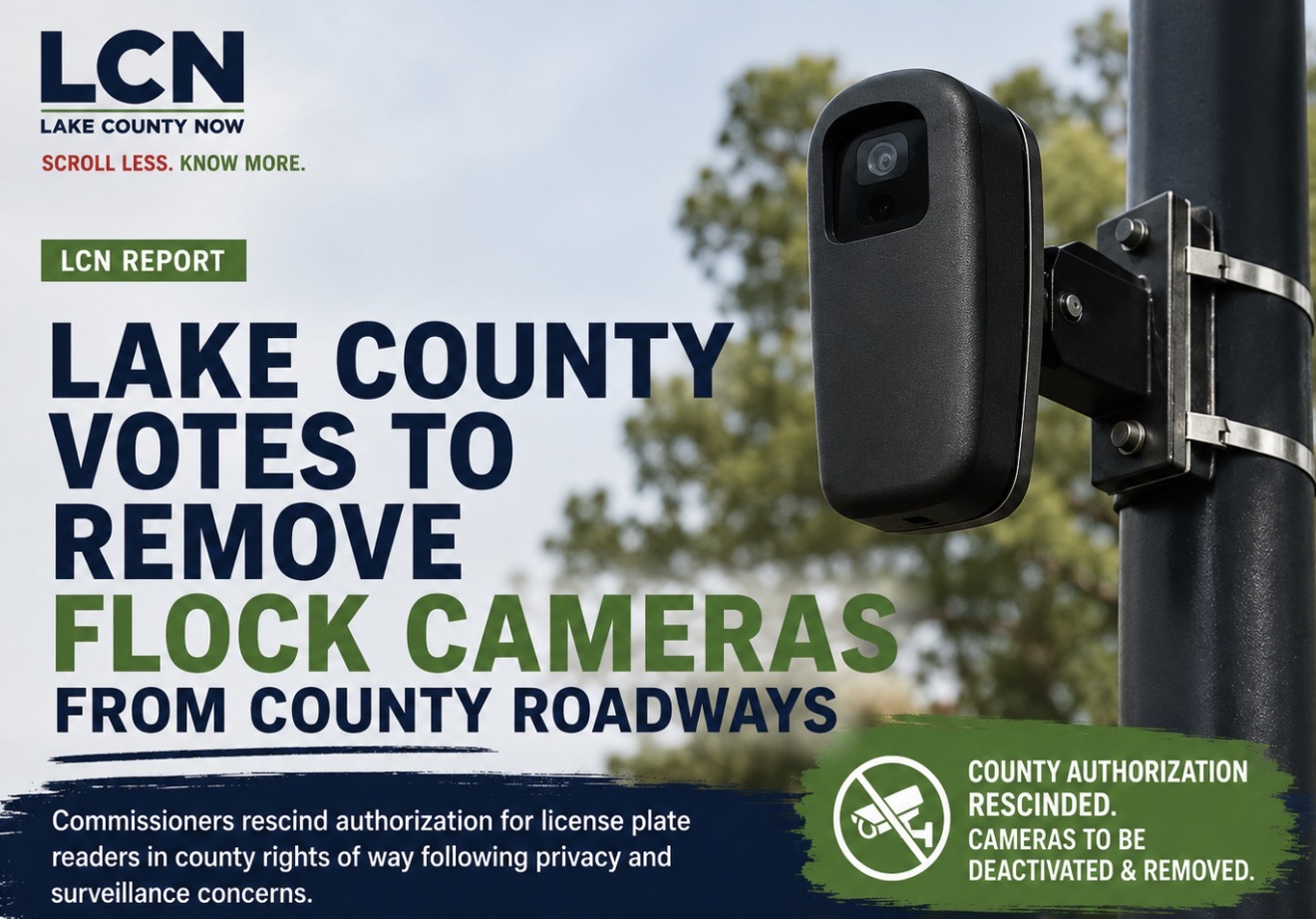
Lake County is withdrawing authorization for automated license plate readers operating within county road rights of way.
The Lake County Board of County Commissioners voted unanimously Tuesday, Sept. 1, on an agenda item concerning whether the county should rescind its previous authorization allowing license plate readers within county-controlled rights of way. Commissioner Anthony Sabatini placed the issue on the agenda.
The decision affects automated license plate-reading systems commonly associated locally with Flock Safety.
These cameras are different from conventional traffic cameras. Automated license plate readers capture information about passing vehicles that can be searched or used by law enforcement during investigations.
The technology has become the subject of growing debate in Lake County.
Residents had previously asked commissioners to remove the cameras during a July 28 commission meeting, raising concerns about privacy, government surveillance and potential misuse of collected information. Law-enforcement supporters of the technology have argued that automated readers can help identify vehicles associated with crimes and assist investigators.
Those competing concerns returned before commissioners Sept. 1.
Following the discussion, the commission chose to withdraw the county’s authorization.
⸻
WHY IT MATTERS
The decision touches on a larger question facing governments throughout Florida:
How much vehicle-location information should law enforcement be able to collect in the interest of public safety?
Automated license plate readers can record a vehicle’s plate as it passes a camera and associate that observation with a particular place and time. Law-enforcement agencies can use those systems to help identify vehicles associated with stolen-car reports, wanted individuals and other investigations.
That capability is also the source of the privacy debate.
Opponents argue that automated systems collect information on large numbers of motorists who aren’t suspected of committing crimes. Their concerns include how information is retained, who can access it, how it can be shared and the possibility that the technology could be misused.
Those concerns are not unique to Lake County.
Other Central Florida agencies have recently reconsidered or suspended their use of automated license plate readers, including agencies in Groveland, Lady Lake and Eustis.
For Lake County commissioners, the Sept. 1 vote resolves one part of that debate: the county will no longer authorize the affected readers within its own road rights of way.
⸻
WHO IT AFFECTS
This is where the scope of the decision is important.
The commission’s action concerns automated license plate readers within Lake County-controlled rights of way.
That is not necessarily the same thing as eliminating every Flock or automated license plate reader located geographically within Lake County.
Different roads and properties can fall under different jurisdictions.
For example, the Florida Department of Transportation controls state highway rights of way, while municipalities may control their own roadways. Cameras may also exist on property outside the county’s direct right-of-way authority.
As a result, residents should not interpret Tuesday’s vote as a blanket statement that all license plate-reading technology throughout Lake County has been eliminated.
What Lake County has done is withdraw its own authorization for the affected systems within county road rights of way.
⸻
WHAT CHANGES
The immediate change is straightforward:
Affected automated license plate readers are expected to be deactivated and removed from Lake County rights of way.
WFTV reported that Commissioner Sabatini said operators would have up to 30 days to remove the cameras. Because that timing currently comes from reporting on the meeting rather than an independently reviewed county removal order, LCN is attributing the 30-day figure rather than presenting it as a separate county document.
Lake County’s vote also comes immediately after a significant change at the state level.
On Aug. 31, FDOT issued Engineering and Operations Memorandum 26-01: “Revocation of General Use Permits for Automated License Plate Readers.”
FDOT’s official records list the memorandum as effective Aug. 31. That action concerns automated license plate readers permitted within state highway rights of way.
These are therefore related but distinct actions:
FDOT → state highway rights of way
Lake County → county-controlled rights of way
That distinction matters when determining which cameras are actually affected.
⸻
WHAT’S NEXT
The physical removal of affected cameras is one thing LCN will continue watching.
But the Sept. 1 vote doesn’t necessarily end Lake County’s discussion about the technology.
Commission Chairwoman Leslie Campione had favored hearing additional information from Lake County Sheriff Peyton Grinnell before commissioners made their decision. The sheriff was not present for Tuesday’s discussion.
After voting to remove the cameras, commissioners also agreed to invite Grinnell to a future commission meeting to discuss automated license plate readers and their use by law enforcement.
That creates several unanswered questions LCN will continue following:
* How many cameras are ultimately affected by Lake County’s decision?
* When will those cameras actually be deactivated and removed?
* What happens to information previously collected?
* Will individual Lake County municipalities take additional action?
* What will Sheriff Grinnell tell commissioners about the technology’s investigative value and limitations?
* Could Lake County revisit its policy under a different framework in the future?
For residents, the immediate takeaway is simpler:
Lake County has withdrawn its authorization for automated license plate readers in county-controlled road rights of way.
What happens with the technology elsewhere in Lake County will depend on the jurisdiction and location involved.