Lake County Sheriff Seeks $12.65 Million for Expanded Drone Program
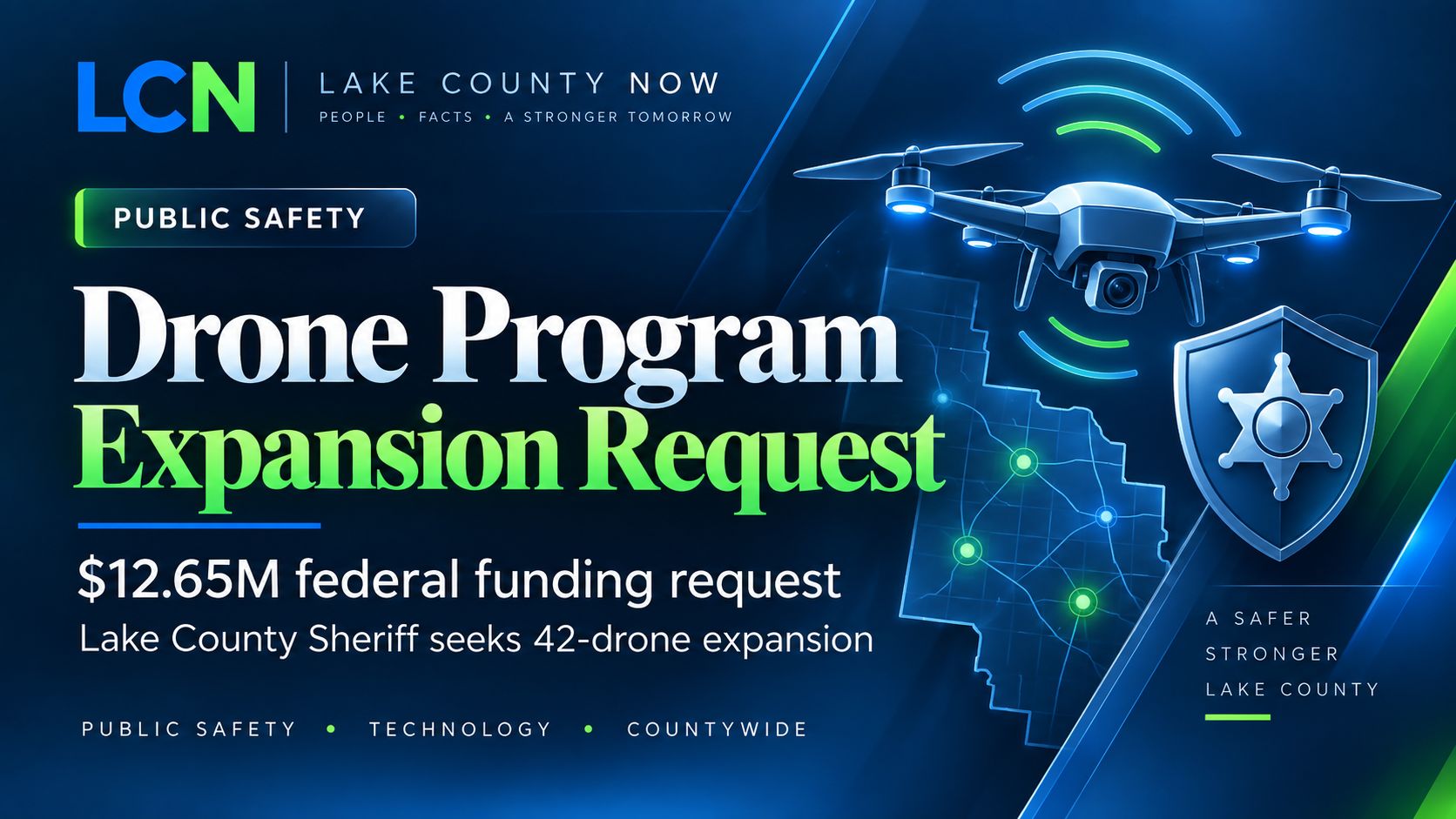
LCSO is seeking $12.65 million in federal funding for an expanded drone program that could increase its fleet from 13 to 42 aircraft and establish seven fixed response locations across Lake County.
Draft for editorial review. Verify grant status and any newly released site, vendor, policy or award details before publication.
The Lake County Sheriff’s Office is seeking $12.65 million in federal funding to expand its drone program and modernize its Real Time Crime Command/Intelligence Center. Lake County commissioners approved the grant application on September 22, 2026.
If awarded, the funding could expand LCSO’s drone fleet from 13 to 42 aircraft and establish seven fixed Drone as First Responder locations throughout Lake County.
The proposed system could be used countywide to assist deputies responding to emergencies, searches, tactical incidents and other qualifying law-enforcement calls.
The proposal would add remotely operated drones positioned at fixed locations, additional patrol-based drones, indoor tactical systems and supporting command-center technology.
The federal government must approve the funding before the proposed expansion can move forward. Additional details, including equipment, fixed-site locations and operating policies, would follow if the grant is awarded.
What Happened
The Lake County Sheriff’s Office is seeking $12,652,826 in federal funding for a major expansion of its unmanned aircraft program.
The Lake County Board of County Commissioners approved the grant application during its September 22 meeting.
The application seeks funding through the U.S. Department of Justice for what LCSO describes as a Drone as First Responder and Aerial Situational Awareness Program.
The proposal also includes modernization of the Sheriff’s Office Real Time Crime Command/Intelligence Center.
According to county agenda materials, the grant does not require a local funding match.
Approval by commissioners allows the county and Sheriff’s Office to pursue the federal funding. It does not mean the money has already been awarded or that the proposed equipment has been purchased.
Why It Matters
LCSO currently operates 13 drones.
Eleven are assigned to patrol vehicles, while two additional systems are designed for indoor use.
Under the proposed expansion, the Sheriff’s Office could increase its fleet to approximately 42 drones.
The proposal includes:
- Seven fixed Drone as First Responder locations
- Two drones assigned to each fixed location
- 15 additional patrol-based drone systems
- Additional indoor tactical drone capabilities
- Upgrades to LCSO’s real-time crime and intelligence infrastructure
The fixed locations would represent one of the largest changes to the current program.
Instead of relying solely on drones carried by responding deputies, aircraft stationed around Lake County could potentially be launched remotely by trained personnel when appropriate calls for service are received.
LCSO says the system is intended to provide deputies with aerial information before they arrive at an incident.
Who It Affects
The proposed program would have countywide applications.
According to LCSO, drones could assist during situations involving:
- Missing people
- Fleeing or wanted suspects
- Dangerous calls for service
- Tactical operations
- Searches of large areas
- Crime scenes
- Traffic incidents
- Situations involving potential threats to life or property
The Sheriff’s Office has said the technology would supplement, rather than replace, deputies and other law-enforcement resources.
LCSO has pointed to Lake County’s geographic size and continued population growth as reasons additional aerial-response capabilities could be useful.
A drone may be able to reach certain scenes before deputies on the ground and provide responding personnel with information about what is occurring.
What Changes
The current LCSO program largely relies on drones deployed from patrol vehicles.
The proposed Drone as First Responder, or DFR, model would add aircraft stationed at seven fixed locations.
Those drones could be operated remotely by trained pilots and dispatched to qualifying calls.
If fully funded as proposed, the expansion would include 14 fixed-site drones, two at each location, in addition to the 15 new patrol-based systems and existing aircraft.
The grant would also support improvements to LCSO’s Real Time Crime Command/Intelligence Center, which would help coordinate information coming from the expanded aerial program.
The Sheriff’s Office has not yet publicly finalized all seven proposed locations.
Federal Funding and Immigration Enforcement
The Sheriff’s Office is seeking the funding through the U.S. Department of Justice’s FY 2026 Bridging Immigration-Related Deficits Experienced Nationwide Program, commonly referred to by the acronym BIDEN.
The federal program provides funding to state and local law-enforcement agencies for eligible operations and equipment associated with criminal immigration enforcement, drug trafficking, gangs, human trafficking and related criminal activity.
Unmanned aerial systems are among the technologies eligible for funding through the program.
LCSO’s grant application states that the expanded drone program could support operations connected to its 287(g) immigration partnership, human- and sex-trafficking investigations and other qualifying federal enforcement priorities.
The Sheriff’s Office has also said the drones would not be limited to immigration-related cases and could be used for other qualifying local law-enforcement operations.
Drone Use Is Regulated Under Florida Law
Law-enforcement drone use in Florida is governed in part by the state’s Freedom from Unwarranted Surveillance Act.
Florida law generally restricts law-enforcement agencies from using drones to collect evidence or information unless certain legal conditions are met.
Authorized circumstances can include:
- Use under a search warrant
- Situations involving imminent danger to life or serious property damage
- Preventing the imminent escape of a suspect
- Searching for missing people
- Certain public-safety operations involving large crowds
- Traffic management
- Crime-scene or crash-scene documentation
Florida law also establishes privacy protections involving observations of private property and places restrictions on the drone systems governmental agencies may use.
Any expanded LCSO program would operate within those state requirements.
What’s Next
The project remains dependent on federal approval.
Lake County commissioners have authorized the application, but the $12.65 million has not yet been awarded.
If the grant is approved, additional decisions and details are expected regarding:
- Locations of the seven fixed drone sites
- Drone and software vendors
- Deployment procedures
- Data storage and retention
- Access to recorded and live video
- Interagency information sharing
- Training requirements
- Equipment maintenance
- Long-term operating costs
Lake County Now will continue tracking the application and any subsequent approvals, purchases or implementation of the proposed program.
KNOW SOMETHING WE DON'T?
Have information about this story or something happening in your community? We want to hear from you.